Today, we continue with part
four of our look at current ballparks that were in use in the mid-1980s. This
time we go to the Midwest for ballpark #3.
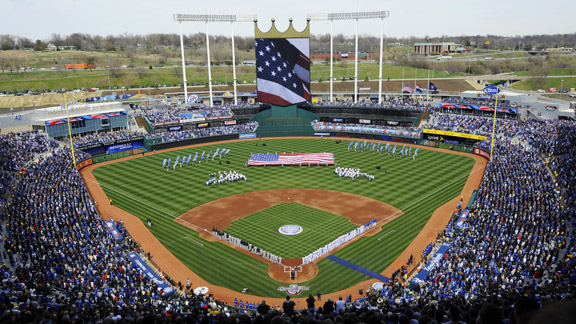
#3. Kaufman Stadium,
Kansas City, Missouri
Home of: Kansas City Royals since 1973
Built in: 1973
Baseball Capacity: 37,903
Previous Names: Royal Stadium
(1973-1993)
History: The city of Kansas City was
awarded an expansion team in the American League for the 1969 season. The
Royals played their first four seasons in Municipal Stadium, once home of the
Kansas City Monarchs of the Negro League. A brand new stadium was built and
ready for the 1973 season just as the Royals were in the midst of putting
together a nucleus of players that would constantly contend for over a decade.
During the ten-year period of 1976 and 1985, the Royals would win the American
League West six times and make the playoffs seven times (the 1981 season had an
additional round due to the players’ strike). They made two trips to the World
Series, losing to the Philadelphia Phillies in six games in 1980 and beating
the St. Louis Cardinals in 1985. Some great players that played in Royals
Stadium are George Brett, Hal McRae, Frank White, Bret Saberhagen, Dan
Quisenberry, Bo Jackson, Mark Gubicza, David Cone, Johnny Damon, Lorenzo Cain,
Erik Hosmer and Salvador Perez.
Charm: Although built during the era of
the cookie-cutter stadiums, Kaufman Stadium doesn’t have the feel of the parks
built in Pittsburgh, Philadelphia and Cincinnati. Even though the outfield
dimensions are symmetrical and the playing surface was Astroturf from 1973
until 1994. The giant scoreboard topped with the crown in centrefield has
always been a landmark of the park. However, after the renovations of 2008, it
changed from the old-school digital scoreboard to an HD version. My favourite
feature of Kaufman Stadium has always been the waterfall and fountain display in
the outfield.
Great Moments:
October 11, 1985: This was Game 3 of
the American League Championship Series. The Royals had lost the first two game
to the Toronto Blue Jays and were in danger of falling behind 3-0 in games, as
they trailed 5-2 going to the bottom of the fifth. After scoring a run in the
bottom of the fifth, George Brett hit a two-run homerun (his second homer of
the game) to tie the game at five. In the bottom of the eighth, Brett singled
and came around to score what would turn out to be the winning run on a bloop
single by Steve Balboni. Brett was four for four in the game with two homeruns,
three RBIs and four runs scored. The Royals would lose Game 4, but reel off
three wins in a row to comeback and advance to the World Series.
September 30, 2014: For the first time
in 29 years, the Royals were in the postseason. They finished in the first in
the Wild Card standings which means they hosted the Oakland Athletics (who
finished second) in the sudden-death Wild Card Game. The A’s were leading 7-3 going
to the bottom of the eighth inning. The Royals scored three runs to narrow the
deficit to one run, and then tied the game in the bottom of the ninth on a
sacrifice fly to send the game to extra innings. Although Oakland scored in the
top of the twelfth to take another one-run lead, the Royals scored two in the
bottom half, hi-lighted by a single down the third-base line by Salvador Perez
to send Kansas City to the American League Division Series.
October 27, 1985 : This was Game 7 of
the World Series and although the outcome was never in doubt (The Royals beat
the St. Louis Cardinals 11-0), the Royals won their first and only World Series
on this night. Twenty-one year old Bret Saberhagen pitched a complete game,
five hit shutout. It was the end of a brilliant season for Saberhagen. He won
20 games during the regular season, won the Cy Young Award and won the World
Series MVP Award after winning both of his starts (Game 3 was the other). Just
like the ALCS, the Royals were down in the Series three games to one, but
managed to win three in a row to comeback and claim the Championship Crown.